
What the next generation of classical architects looks like — reflections from serving as a jury member at Notre Dame's Rome Studies Program, and why the ability to draw by hand remains one of the most important foundations of good design.
Drawing Their Way Forward: Reflections on the Next Generation of Classical Architects
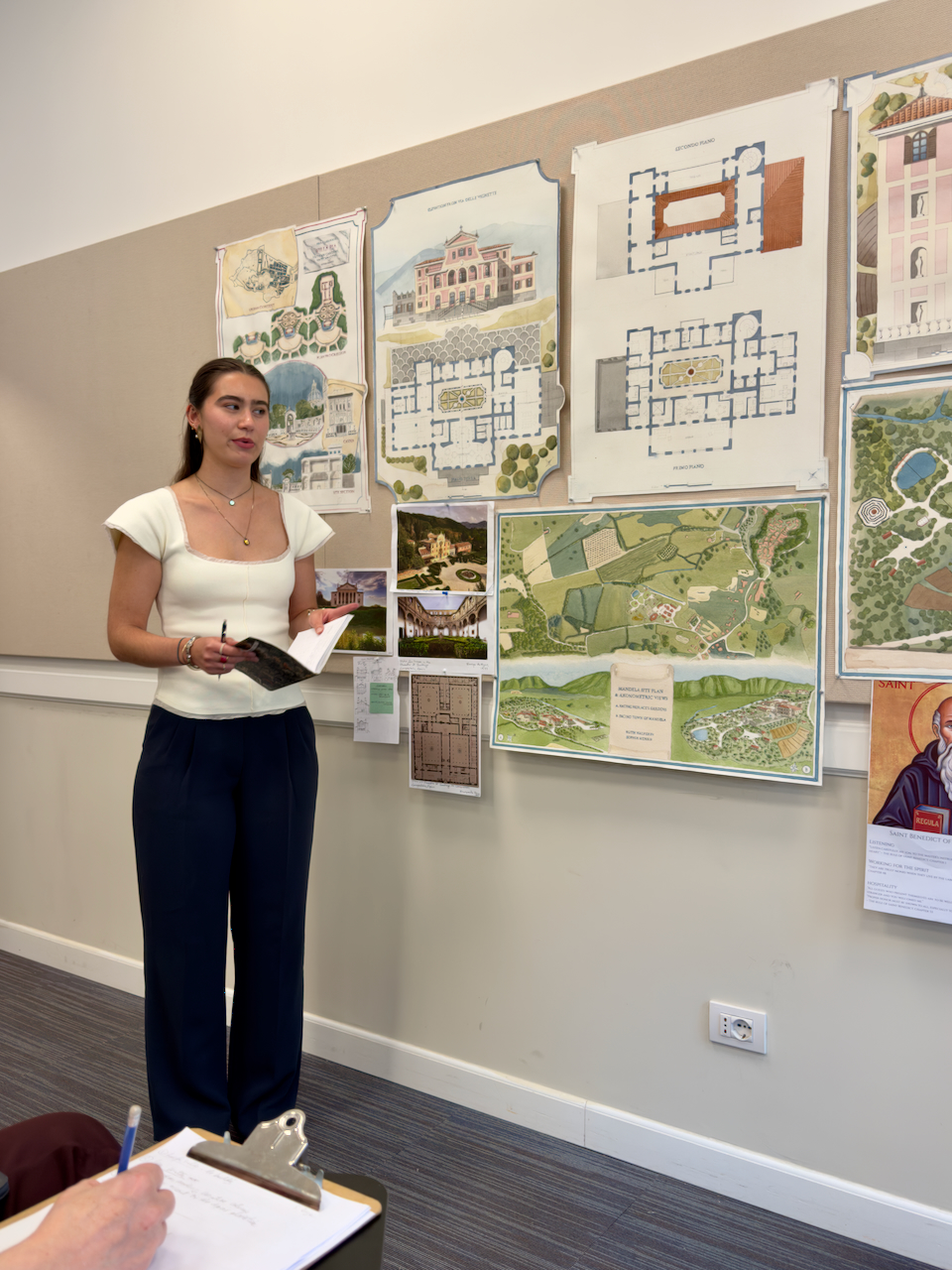
On the morning of May 5, 2026, I took my seat as a jury member for the final design review of the University of Notre Dame's Rome Studies Program. Over the course of that day, more than 50 third-year undergraduate students presented the culminating work of a full academic year spent living, studying, and designing in Rome. What I witnessed left me genuinely encouraged about the future of classical architecture.
A Program Unlike Any Other
Notre Dame's Rome Studies Program is, by any measure, exceptional. Founded in 1969, it is the only foreign studies program at an American architecture school that requires every undergraduate student to spend an entire academic year abroad. Students live and work near the Colosseum, immersed in one of the world's great repositories of classical and traditional architecture. Their curriculum combines design studios, history and theory, and intensive courses in hand sketching and painting — all grounded in the principle that Italy's historic cities are not relics to be observed, but living resources from which to learn how to design.
The program is not producing students who happen to have spent a semester in Europe. It is producing architects who have spent a formative year being trained to see.
The Project: A Villa Near Mandela
This spring semester, students were asked to design a classical villa and spa resort near the village of Mandela in the Lazio countryside — a site of remarkable historical depth. This is the same landscape that inspired Horace, drew Goethe, and provided Jean-Baptiste Camille Corot with some of his most celebrated subjects. The area has an ancestral connection to the idea of the villa as a place of retreat, contemplation, and civilized leisure that stretches back to antiquity.
Students were asked to work within the Italian villa typology: a design tradition characterized by the integration of indoor and outdoor space through loggias, terraced gardens, axial planning, and a clear hierarchy of rooms that moves from the formal to the intimate, from the public to the private. To this they added a contemporary program — spa facilities, a reception hall, guest accommodation — all of which had to be resolved within a coherent classical composition and presented in hand-drawn plans, elevations, sections, and watercolor perspectives.
It is a demanding brief. And the best work showed it.
Confidence, Clarity, and the Ability to Draw
What distinguished the exceptional presentations was not complexity or ambition for its own sake. It was confidence — a quiet, earned confidence visible in every layer of the work.
The best projects had a continuity of form and material that held together from the site plan to the smallest detail. The text on the boards read at the correct scale. The borders framed the compositions with intention. The drawings communicated not just what the buildings looked like, but what it would feel like to move through them — to arrive at the estate, to pass through a loggia, to step from the main hall into the garden. There was a clear hierarchy of spaces and circulation, and you could see yourself living and working there.
What also stood out was how these students presented. They spoke with purpose, framing their projects without overstating them, and allowing the drawings and the design to carry the argument. When jurors offered critique, they listened. They engaged. They welcomed different perspectives rather than becoming defensive. That kind of professional maturity is not always easy to find — at any level.
Underlying all of it, in my view, was one foundational skill: the ability to draw by hand.
Why Drawing Matters
This is a point I find myself making often. When I look at student work and ask what separates the best from the rest, drawing is almost always part of the answer — not as an isolated technical skill, but as evidence of a trained eye.
Drawing by hand is a cognitive exercise. It slows you down. It forces deliberate decisions. Every line is a judgment about proportion, scale, light, and relationship. When students draw buildings on site — measuring a cornice, sketching a loggia, working out a section by hand — they are not just producing a record of what they see. They are learning to see more precisely, more completely, than they could through any other method.
The concern in architecture education today is that this skill is being lost. Most programs have shifted toward digital-first workflows, and hand drawing has moved to the margins — an elective, an afterthought, or simply something students are no longer expected to do. The consequences are real. Designers who have never drawn carefully often struggle to evaluate proportion, to read a façade with any depth, or to develop what is sometimes called a design eye — the accumulated visual judgment that allows you to sense when something is right.
Notre Dame's Rome program has not made that concession. Its students draw. And it shows.
What This Signals
There is a broader context worth noting. The skills these students are developing — classical composition, typological thinking, careful drawing, urban awareness — align directly with what the profession is increasingly being asked to produce: walkable, human-scaled, contextually grounded design. New Urban communities, traditional neighborhood developments, and civic buildings that belong to their places are not niche requests. They reflect a genuine and growing appetite for architecture that endures.
The students I reviewed in Rome are preparing to meet that demand. They are serious, well-trained, and clearly motivated by the right things. Sitting across from their work for a full day, I came away with a straightforward conclusion: classical architecture is in capable hands.
It was an honor to be in that room.
Sources: University of Notre Dame School of Architecture — Rome Studies Program (architecture.nd.edu); Notre Dame Rome — School of Architecture Rome Studies Program (rome.nd.edu); NDWorks — Rome Studies Program Celebrates 50 Years (ndworks.nd.edu); Perkins Eastman — The Proliferation of AI Reinforces the Need for Architectural Sketching by Hand; Institute of Classical Architecture & Art — Seeing, Drawing, Thinking Lecture Series; ScienceDirect — Characterization of Conception Drawing in Architecture; Metropolitan Museum of Art — The Idea and Invention of the Villa.